Auto Repair Shop Workflow: The 8 Stages of Every Job
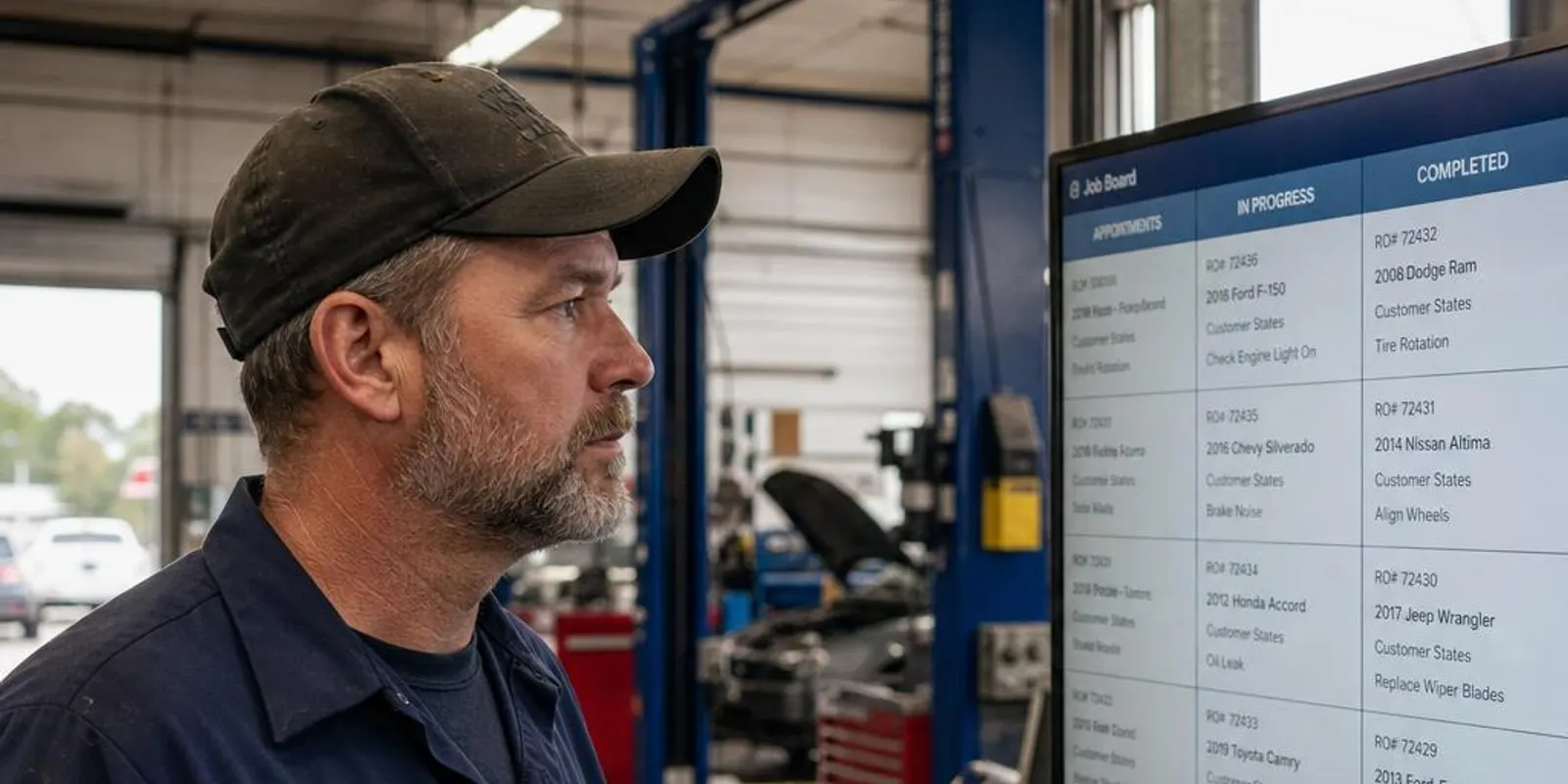
"Is my car ready?"
The customer's on the phone. Nobody on the floor knows. The job card is in someone's pocket, the extra work was approved by phone, and the invoice hasn't been written yet.
Sound familiar? Most shops don't lose money on the repair itself. They lose it between the steps. This guide breaks your auto repair shop workflow into 8 clear stages. For each one it shows what to record, who owns it, and where money quietly slips away.
Key takeaways
- Every service job passes through 8 stages: New → Checked-in → Inspection → Estimation → Work Started → Work Done → Invoiced → Delivered.
- Each stage needs one owner and one record. If it isn't written down, it didn't happen.
- The biggest money leaks happen in 3 gaps: unsold inspection findings, finished cars waiting to be invoiced, and unpaid pickups.
- A shared, visible job board (on a wall or in software) is the fastest way to close those gaps.
What is an auto repair shop workflow?
An auto repair shop workflow is the fixed sequence of steps every vehicle follows, from the first booking to the moment the customer drives away and the invoice is paid. A good workflow gives each step a clear owner and a record. That way anyone in the shop can answer "where is this car, and what's next?" in seconds.
Without one, the process lives in people's heads. It works fine at three cars a day and falls apart at fifteen.
The 8 stages at a glance
| # | Stage | What happens | Owner | What to record |
|---|---|---|---|---|
| 1 | New | Booking or walk-in is logged | Front desk | Customer, vehicle, complaint, requested date |
| 2 | Checked-in | Car arrives, keys received | Front desk / service advisor | Mileage, fuel level, condition photos, customer signature |
| 3 | Inspection | Technician diagnoses the issue | Technician | Findings, photos, recommended work (urgent vs. later) |
| 4 | Estimation | Parts and labor are quoted and approved | Service advisor | Line-item quote, approval (who, when, how) |
| 5 | Work Started | Car goes on the lift | Technician | Start time, parts used, extra findings |
| 6 | Work Done | Job finished and quality-checked | Technician / foreman | QC check, road test, finish time |
| 7 | Invoiced | Bill is issued | Service advisor | Final invoice matching the approved quote |
| 8 | Delivered | Car handed back, payment taken | Front desk | Payment method, handover notes, next-service reminder |
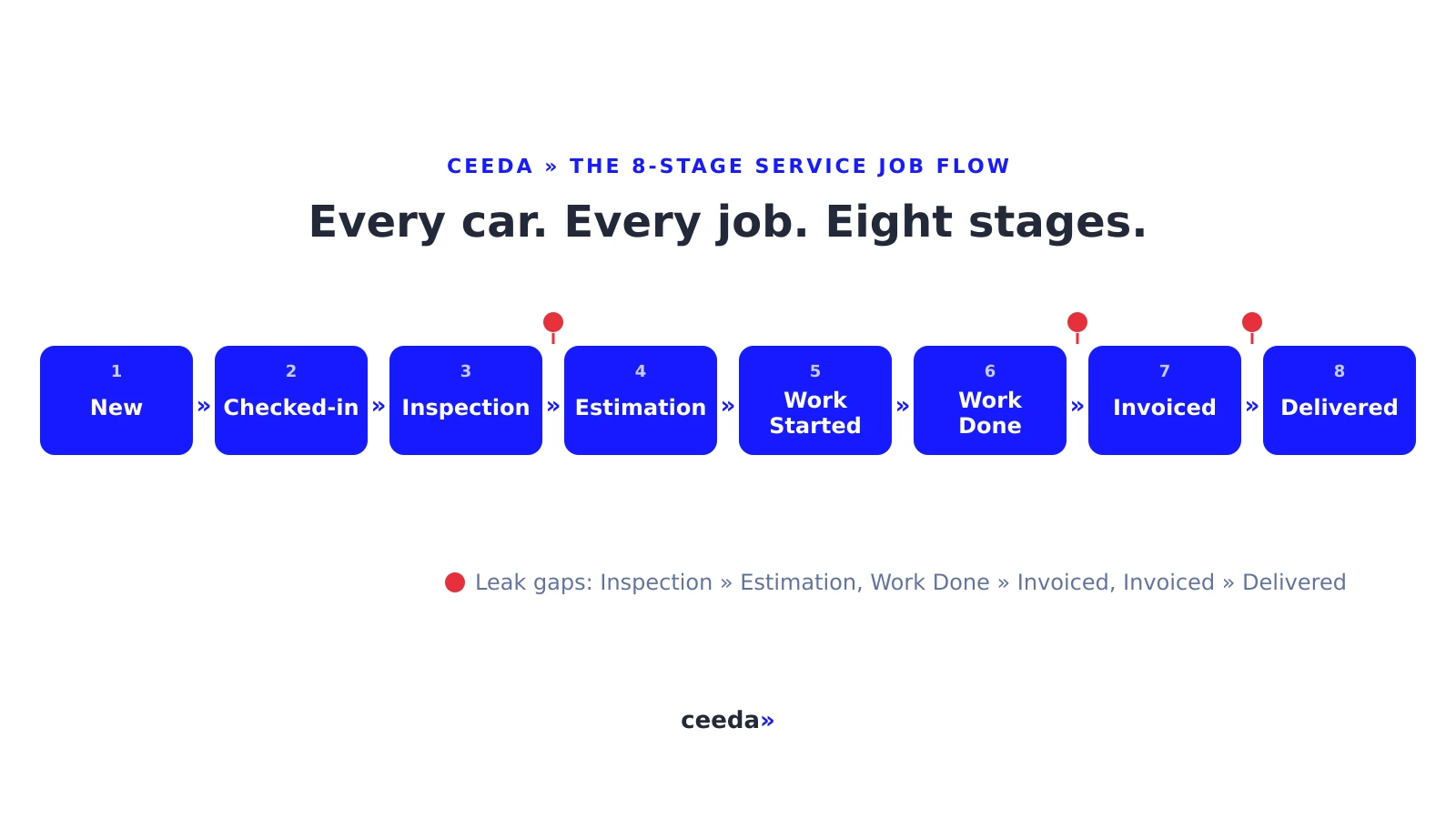
- New
- Checked-in
- Inspection (leak gap before Estimation)
- Estimation
- Work Started
- Work Done (leak gap before Invoiced)
- Invoiced (leak gap before Delivered)
- Delivered
Red dots mark the 3 gaps where repair shops lose the most money.
Stage by stage: what to record and where it leaks
1. New: capture the job properly from the first call
Write down the customer's complaint in their own words ("grinding noise when braking, front left"), not just "brakes". A vague first note means a longer diagnosis later.
Leak: bookings taken on sticky notes or in a personal WhatsApp chat that the rest of the team never sees. The result is no-shows and double-booked bays.
2. Checked-in: protect yourself before touching the car
Record the mileage and fuel level, and take 4–6 photos of the car's condition in front of the customer. Get a signature (paper or digital) that authorizes inspection.
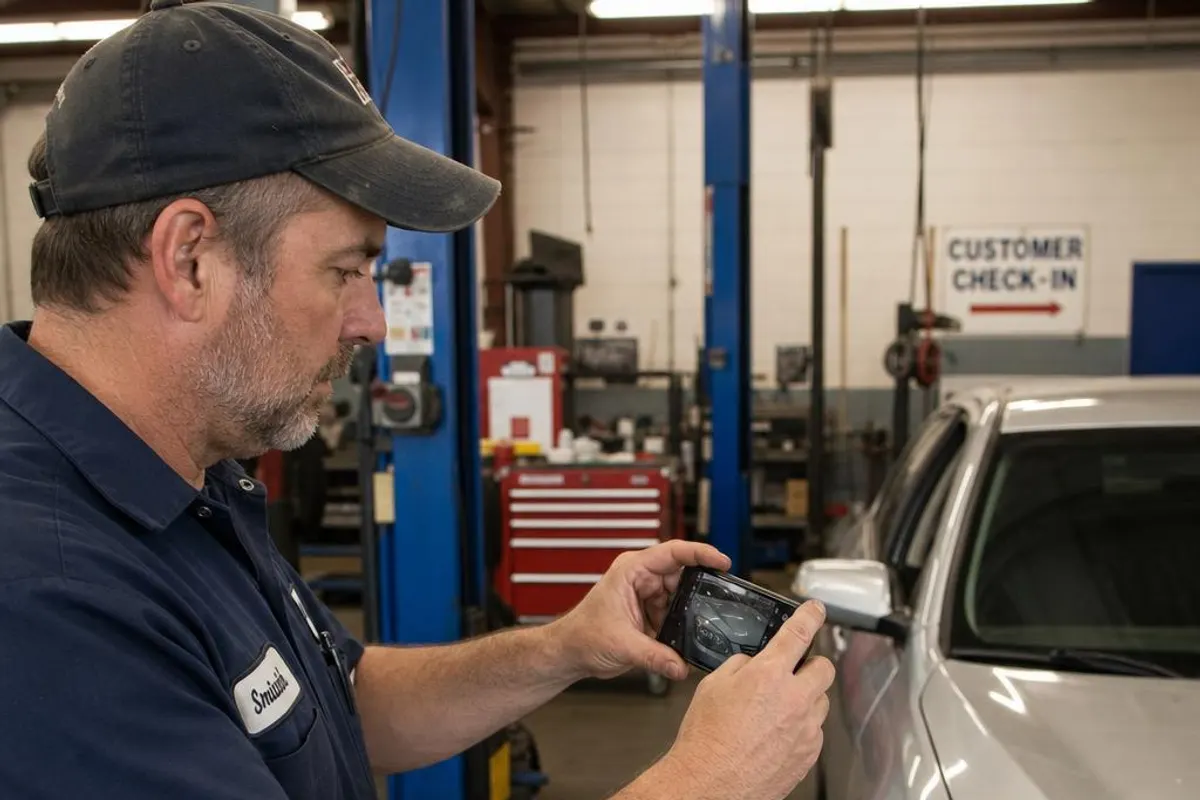
Leak: a customer claims a scratch "wasn't there before". Without check-in photos, it's your word against theirs, and your margin pays for it.
3. Inspection: find everything, write everything
The technician diagnoses the reported problem and notes anything else worth flagging: worn tires, leaking seals, overdue service. Split findings into urgent and can wait, with a photo for each.
Leak: extra issues the technician spots but never writes down. Every unwritten finding is a job you never had the chance to sell.
4. Estimation: get approval on record
Turn the findings into a clear, line-item quote for parts and labor. Send it in a format the customer can read on their phone, and record the approval: who approved it, what they approved and when.
Leak: approvals given by phone with nothing in writing. That leads to disputes at pickup, discounts to keep the peace, and unpaid extras.
5. Work Started: one job, one bay, one clock
Mark the car as started and log the parts as they're used. If the technician finds something new mid-job, it goes back to Estimation for approval. Never do the work first and ask afterwards.
Leak: parts pulled from stock without being logged against the job, so they never reach the invoice.
6. Work Done: quality-check before you call
Run a quick QC: test drive, fluid levels, no tools left in the engine bay, the car cleaned if that's your standard. Only then mark it done.
Leak: a car that comes back tomorrow with the same problem. Comebacks cost you a bay, a technician's time and the customer's trust.
7. Invoiced: bill the same hour the work is done
The invoice should match the approved estimate plus any approved extras, with no surprises. Issue it as soon as the car is marked done, not at the end of the day or week.
Leak: the classic one. Finished cars sit in the yard waiting for paperwork, and your cash sits with them.
8. Delivered: close the loop
Explain the work done, take payment, hand over the keys, and set the next-service reminder before the customer leaves. That reminder is your next booking.
Leak: cars released "on account" that are never chased, and customers who don't come back because nobody reminded them.
The 3 gaps where repair shops lose the most money
Looking across the 8 stages, most lost revenue clusters in three handoffs:
- Inspection → Estimation (unsold work). The technician saw it, but it never made it onto the quote. Fix: no inspection is complete without written findings and photos.
- Work Done → Invoiced (slow billing). The car is ready but the invoice isn't. Fix: make "invoice issued" part of finishing the job, not a separate admin task.
- Invoiced → Delivered (unpaid pickups). The keys go out before the money comes in. Fix: no handover without a recorded payment or an agreed, dated payment plan.
A quick way to size your own leak: count how many finished cars are sitting in your yard right now without an invoice. Multiply that by your average ticket. That's cash you've already earned and haven't collected.
How to track your workflow: whiteboard vs spreadsheet vs software
| Whiteboard | Spreadsheet | Garage management software | |
|---|---|---|---|
| Cost | Almost free | Free | Monthly subscription |
| Visible to the whole team | Only in the workshop | Only if someone opens it | Yes, on any device |
| Photos and approvals | No | Awkward | Built in |
| Links quote → invoice → payment | No | Manual | Automatic |
| Works at 15+ cars a day | Gets messy | Gets messy | Yes |
| Best for | 1–2 bays, owner on the floor | Small shops starting out | Shops ready to grow |
Any system beats no system. Even a whiteboard with 8 columns will show you where cars pile up. Once you're juggling more than a handful of jobs, software earns its keep, because it connects the stages instead of relying on someone to copy information from one to the next.
That's exactly what Ceeda is built for. Every job moves across the same 8 stages on one board, from booking to delivery, with quotations, invoices and payments attached to the job itself.
Your 10-point workflow checklist
- Every booking is logged in one shared place, not personal phones
- The customer's complaint is recorded in their own words
- Condition photos are taken at every check-in
- Inspection findings are written and photographed, split into urgent and can wait
- Every estimate has a recorded approval (who, what, when)
- New findings mid-job go back for approval before any work
- Parts are logged against the job as they're used
- A QC check is done before a car is marked done
- The invoice is issued within the hour of Work Done
- No car leaves without payment recorded and a next-service reminder set
FAQ
What are the steps of a car service at a repair shop?
A car service at a repair shop typically follows 8 steps: the job is booked (New), the car is received and documented (Checked-in), diagnosed (Inspection), quoted and approved (Estimation), repaired (Work Started), quality-checked (Work Done), billed (Invoiced), and handed back with payment (Delivered).
What is a repair order in an auto shop?
A repair order (also called a job card) is the working document for one vehicle's visit. It records the customer and vehicle details, the complaint, the technician's findings, the approved work, the parts and labor used, and the final charges. It follows the car through every stage of the workflow.
How do auto repair shops track jobs?
Most shops track jobs with a whiteboard, paper job cards, a spreadsheet or garage management software. The most reliable method shows every car's current stage to the whole team in one place and links the estimate, invoice and payment to the same job, so nothing is re-typed or forgotten.
How can I make my auto repair shop more efficient?
Give every job a clear stage and a single owner. Record findings and approvals in writing, and invoice as soon as work is done. Put everything on one visible board. Most efficiency gains come from removing the waiting and confusion between steps rather than making technicians work faster.
Where do repair shops lose the most money?
Most lost revenue comes from three gaps: inspection findings that never reach the estimate, finished cars waiting to be invoiced, and cars released before payment is collected. Closing these gaps usually recovers more money than raising labor rates.
The bottom line
Your workflow already has 8 stages whether you've named them or not. The shops that run smoothly just make those stages visible, give each one an owner, and never skip the record. Start by counting the finished-but-not-invoiced cars in your yard today. That number tells you how much a clear workflow is worth to you.
ceeda »
Run your garage smarter
Bookings, service jobs, estimates, invoices and payments — one simple system that takes every car from check-in to delivery.
Try Ceeda Now »